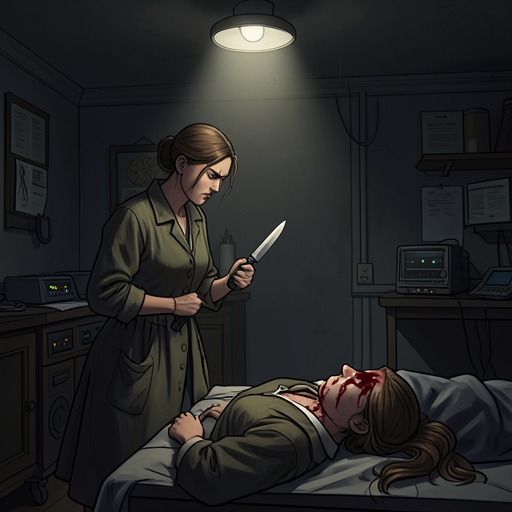
Zoe Hardy’s captivity
The CageZoe Hardy’s captivity begins when Ken Carlton abducts her from her home and carries her to the loft where Jill Richards is imprisoned. Her arrival changes Jill’s prospects from a threatened release to a new and immediate danger: Ken identifies Zoe as her replacement, while Jill recognizes that both women must escape. The captivity ends with police reaching the loft, freeing them and calling for medical assistance.
Background and Abduction
The investigation had already traced how several women disappeared during ordinary journeys. Becky Allsopp had travelled from Newcastle Central Station to Sunderland and vanished after leaving the Metro near the Stadium of Light, beyond the CCTV coverage. Louise Usher sometimes walked home from the gym, sometimes took a bus, and only occasionally used a taxi. The investigators suspected that victims were being taken into a vehicle, although they had no reports of shouting or screeching tyres. Those uncertainties made the way women travelled—and the opportunity to approach them without attracting attention—central to the case.
CCTV of Jill showed her leaving a supermarket, walking past McDonald’s in the direction of Roker Avenue, disappearing briefly from view and then appearing at a bus stop outside the Salvation Army. A showroom opposite recorded her checking the timetable before flagging down a car that looked like a black cab. The vehicle had no sign on its roof. Eve Strong connected this evidence to the police warning that people should hail only white cars bearing a taxi sign. The footage exposed how the warning could be circumvented by a vehicle that looked like a cab but did not meet the advice given to the public.
Zoe’s abduction followed a different route: Ken took her from her own home rather than intercepting her during a journey. He incapacitated her, bound her, concealed her in a packing crate and transported her to his home. The contrast with Jill’s journey shows that the apparent taxi pattern did not describe every abduction. For Zoe, a familiar domestic setting became the point of entry into captivity.
Arrival in the Loft
Jill was dozing when the back door slammed, and the noise marked another change in the loft. Still stiff, sore and hungry, she was already living with the consequences of an earlier attempt to escape; the pain in her wrist brought that failure back to her. She had been afraid since getting into the taxi the previous Friday evening. Her captivity thus joins the larger pattern of the abduction investigation to an immediate, bodily awareness of danger and failed resistance.
The loft hatch opened soon after the door below had shut. Ken climbed up carrying Zoe over his shoulder, then dropped her onto the floor. Jill noticed that Zoe was bound but still wearing what appeared to be her own clothes, unlike the ugly tunics worn by earlier abductees. The timing and clothing suggested to Jill that this captive was being treated differently. She did not know why, but considered whether the change might offer her an advantage.
Ken tied Zoe by the wrists to the side of the cage while she remained barely conscious. He then told Jill that Zoe was her replacement, explaining that he had reconsidered which part of Jill he wanted to keep as a reminder. His announcement made the captor’s system of replacing one woman with another explicit: Zoe’s arrival did not mean Jill was safe, and it placed Zoe in the position Jill had occupied. Ken left the loft, switched off its light and closed the hatch, leaving the women together in darkness.
Captivity and Shared Danger
When Zoe came round, she was confused about where she was and why her head hurt. Jill introduced herself and answered her questions with what she knew of Ken’s pattern. She told Zoe that earlier victims had been taken in his fake taxi and that she herself had suffered repeated sexual abuse. That history made Jill’s warning about the danger ahead more than a general fear: she understood that Ken’s treatment of captives followed a recurring pattern and believed what came next would be horrific for them both. The account also gave Zoe information the captor had not provided, allowing her to understand the urgency of their situation.
Zoe tugged against the rope binding her to the cage and declared that they had to get away. Jill agreed. The exchange brings the two women together not through an established relationship but through their shared confinement and their recognition of a common threat. Jill’s experience gives her knowledge of Ken’s methods; Zoe’s first response is to resist the restraint. The evidence does not establish that they found a way out themselves before the rescue, but their exchange makes escape the immediate purpose they share.
Discovery and Aftermath
Eve Strong found the concealed loft hatch by using a long pole with a hook to pull it down and lower the ladder. In the loft, Jill called for help and said Zoe needed an ambulance. Bill Nicol untied Zoe, who was unconscious beside the cage, and then freed Jill’s wrists from its sides. Eve requested medical help and backup from Gary Baxter, as well as food for the women. When Eve asked about Zoe’s condition, Bill reported that she had a weak pulse and that medical staff were urgently needed.
The rescue ends the confinement but does not erase its consequences: Zoe is unconscious and in need of immediate care, while Jill has endured captivity, hunger and an unsuccessful attempt to escape. The contrast between the public warning about taxis and Zoe’s abduction from home also shows the limits of treating the disappearances as a single, uniform sequence. The loft brings those different routes into the same place, where Ken’s replacement scheme makes the danger to both women visible and the police intervention finally interrupts it.